Nature| Queen cell architecture shapes honey bee queen development
Date:2026-06-10
Honeybees (Apis spp.) are famous for their architectural abilities and the remarkably consistent honeycomb that they make. The bulk of their nest is made of hexagonal cells arranged in 3D parallel sheets of honeycomb. Workers (which are always female) build this comb from wax secreted beneath their abdomen and use the comb to store food and rear young. Two sizes of hexagonal cells are built: smaller ones for rearing workers, and larger ones for rearing drones, the reproductive males. Workers build a third type of cell specifically for rearing queens, the reproductive females, and these cells buck the trend in several ways — they are not hexagonal, they protrude downwards rather than being oriented horizontally and workers build them only when rearing new queens.
On June 3, 2026, the research teams for Bee Resources and Breeding and for Bee Product Quality and Risk Assessment of the Institute of Apicultural Research, Chinese Academy of Agricultural Sciences, together with the Bee Product Quality Inspection and Testing Center(Beijing), Ministry of Agriculture and Rural Affairs, collaborated with several other institutes and published a study titled "Queen cell architecture shapes honey bee queen development" in the prestigious scientific journal Nature, revealing the importance of these homes for queen bees.
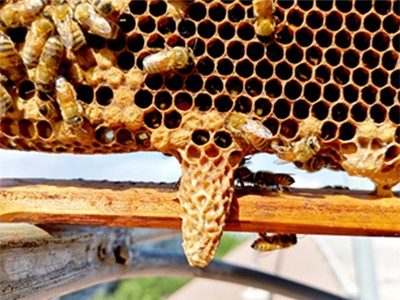
Queen cells are typically a dreaded sight for beekeepers. The cells indicate that the bees are preparing to swarm (during which a large portion of the worker bees and the current queen depart to look for a new home) or have already swarmed, or the current queen is ailing and the workers are attempting to replace her. People have recognized these specialized cells for as long as beekeeping has existed; even earlier, foraging honey hunters would have noticed them because they are filled with royal jelly, which has a distinctive, zingy, sour-yoghurt taste. Unlike the highly consistent hexagonal cells holding honey, queen cells stick out, protruding from the lower edge of the comb, their pockmarked wax resembling a peanut shell (Fig. 1).
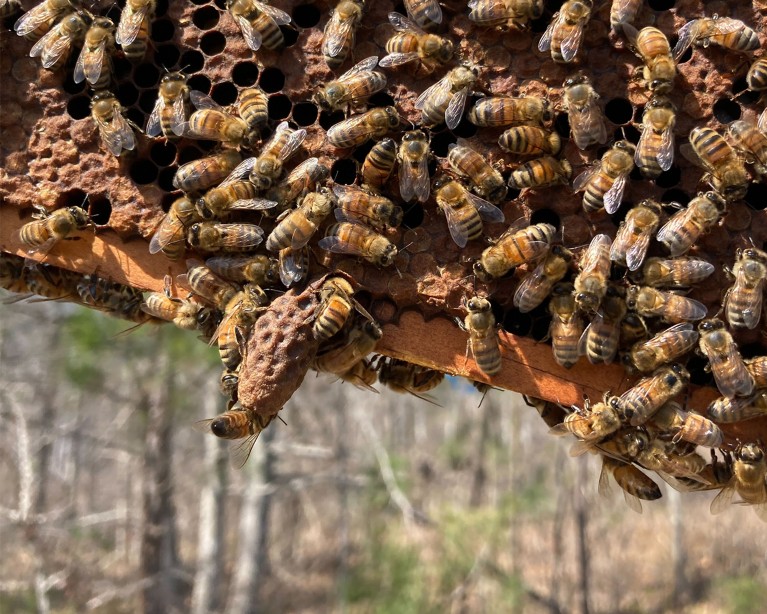
Figure 1 | Honeycomb. A comb containing many hexagonal worker cells and a single queen cell, which resembles a peanut shell and is oriented downwards on the lower edge of the comb.Credit: Peter R. Marting
Surprisingly, although queen cells are conspicuous and crucial for colony function, in research they are typically ignored or regarded as inert vessels that simply hold royalty, rather than having an active role in shaping the development of the queen. The researchers looked at western honeybees (Apis mellifera) to reveal the developmental implications of this specialized architecture, which has physical and chemical specifications that are influenced by the behaviour and gene expression of the worker bees that build it.
The researchers investigated the physical properties of the wax of queen cells compared with that of worker cells. Using scanning electron microscopy, the researchers show that worker-cell wax is denser than queen-cell wax. This is unsurprising given that queen cells are single-use (built for a single queen and torn down afterwards), whereas worker cells are used repeatedly and have a number of purposes. When the researchers remoulded the two wax types into identical shapes, their material properties were different: wax from queen cells is more malleable and has a higher melting point than that of worker-cell wax. This result suggests that the chemical profiles of the waxes are different, and the researchers show that each type of wax has unique chemical properties, including wax-type-specific molecules called volatile organic compounds.
The role and rule of relatedness in altruism
These physical and chemical differences raised the question of whether bees behave differently depending on the type of wax they’re working with. Using dyed wax from worker cells, the researchers show that workers readily incorporated it into both queen and worker cells, but dye density was lower in queen cells. This suggests that workers are choosier about the wax that gets incorporated into queen cells.
Using cameras and thermal imaging, the researchers show that workers building queen cells have a higher thoracic temperature than do those engaged in any other tracked behaviours, including building worker comb, waggle dancing (a movement to communicate the location of resources) and nursing. This elevated temperature is a physiological marker of a group of workers with a distinct behavioural role, and it also has a genetic basis: using a technique called RNA-sequencing analysis, the researchers uncovered differences in gene-expression levels between workers building queen cells versus those building worker cells. Behavioural differentiation was further supported by monitoring groups of bees with known ages; queen-cell builders were younger than worker-cell builders, and they expressed higher levels of wax-synthesis genes.
Together, these results show that workers are specifically crafting a queen-rearing microenvironment with distinct physical and chemical properties, and that they have specialized behaviours and gene-expression profiles that enable them to do so. But does this actually matter for a developing queen? The key test is to rear young queens in wax environments made from either queen-cell or worker-cell wax — that is, to collect wax from each type of cell source and randomly allocate it to developing queens.
A cocktail of pesticides, parasites and hunger leaves bees down and out
To carry out this seemingly impossible experiment, the researchers placed larvae in plastic queen-cell cups, which were then introduced to a bee colony to trigger queen development. the researchers then removed the queen-cell cups from the colonies, replaced the wax cap that the workers had built with one that the researchers built themselves, and put the queen-cell cups into an incubator to prevent the colony from modifying the cap or the rearing conditions. Developing queens that were given a cap built from queen-cell-derived wax had a higher survival rate and were heavier than their counterparts that were given a cap built from worker-cell-derived wax. This pattern was consistent across trials over several months, and was repeated using another honeybee species (Apis cerana).
By studying the specifics of queen cells, the researchers open questions about nests overall, and the active roles that invertebrates take in shaping their environment. Much like a spider producing various types of silk for its web, so too are the bees modifying their building materials, depending on where they are, and which bees they are for. Whether workers are secreting a specific type of wax directly, or are ‘simply’ modifying it after secretion, remains to be answered. This work also raises questions about the potential for numerous signals and cues to be embedded in this living architecture. And what happens to queen wax once the new queen has been reared successfully? Is it modified back into worker-type wax, or is it diluted throughout the nest, rearing generations of workers with the faintest whiff of the royal life they might have lived?
In the world of animal architecture, the nests of honeybees have always had a special place of honour. The translated words of ethologist Karl von Frisch, decipherer of the waggle dance, ring forever true: “The life of the bees is a magic well. The more you draw from it, the richer it flows.”
Article Link: doi: https://doi.org/10.1038/d41586-026-01580-y
News and Views Source: https://www.nature.com/articles/d41586-026-01580-y